

Healing Insight
By Linda Pouliot
Defining Healing Insight
Healing insight is the ability to gain an understanding of your internal experience after the death of a loved one or after any other type of loss. Your emotions, thoughts, feelings, bodily sensations… The pain.
Healing insight occurs when we can define what healing means. So, let’s go.
Breaking Down the Process of Healing
- Healing is the ongoing process of sorting out, processing and making sense of what occurred.
- Healing is the ongoing process of learning to accept all aspects of the loss. Including any secondary loss. Accepting does not necessarily mean liking.
- Healing is the ongoing process of assimilation and integration of all aspects of the loss into every cell in our body and into our ongoing life story and our ongoing family story.
- Healing is the process of adapting to all of the unwanted change—and sometimes the wanted change that is brought about by the loss.
- Healing is the process of creating new meaning in our life and at the same time moving into a new way of being without forgetting the old.
- Healing means returning to some type of internal sense of normal once again. Sometimes we return to sense of normal that feels similar to what we experienced before the loss occurred. And sometimes we experience a new and very different sense of internal normality. Or we can experience anything in between.
Permanent Loss of a Loved One
After the death of a loved one—or when we are permanently separated from a loved one. For example, termination of paternal rights or the abduction of a loved one with no resolution. We move from having a physical relationship with our loved one to one of memory.
Which boils down to this. The healing process includes the ongoing process of our brain and heart—and every cell in our body rewiring to a new environment which no longer includes our loved one. Because we have moved from having a physical relationship to one of memory. This is tough mental, emotional and physical work.
Dr. Caroline Leaf shares the following in her book, Who Switched Off Your Brain, solving the mystery or he said/she said:
“Falling in love has a massive chemical influence on our brains that impacts us on a physical level. Because of this, the death of a spouse is especially traumatic and painful because of the neurochemical bonds deep in the brain… When these neurological bonds are broken, they produce physical pain in both the brain and the body as a result of the massive amounts of bonding chemicals that accompany a long-term loving relationship. (The same holds true for all types of permanent separation from a loved one. -Linda)
It takes time for these chemical bonds to dissolve. The deep limbic system misses the person’s voice, touch, and smell. Thinking of all the good memories that have been shared over the years helps with the healing process because of the chemicals that are re-activated. A similar process takes place during divorce but can be more complex and difficult because it often lacks the same level of closure.” (Chemical bonds dissolving does not mean forgetting because it is not possible to forget someone that we love. -Linda)
Here’s the Thing
No matter what type of loss we experience. Death of a loved one, divorce, termination of parental rights, loss of job, empty nest, selling our home… Our brain has to rewire to not only who is missing but what is missing. Including role and responsibility changes and schedule changes… And as our brain rewires, we grieve and we heal. In other words, we acknowledge what we are thinking and feeling and work through what we are thinking and feeling. Sometimes over and over again.
Action Steps
Don’t minimize how hard you are working. Mentally, emotionally, physically and even spiritually. Get up out of your chair. Walk, run… Post your resume online. Hydrate with plain water. Eat whole food. Get up and move. Meet with friends. Join a small group at church. Take your children to the park or out to a movie… You are not alone and as difficult as this is. You got this!
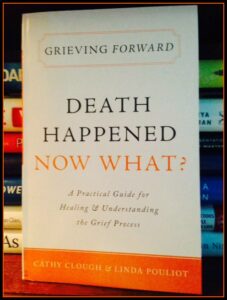
Time to get your copy of this book.
Endnote